Lose weight vs Burn fat
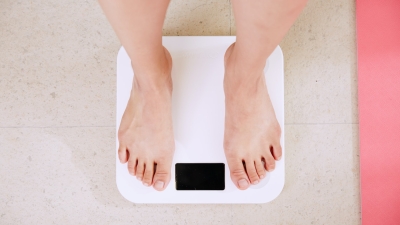
When people say they want to lose weight, they mainly mean that they want less fat tissue. There are many crash diets that allow you to lose a lot of weight quickly, but it is mainly fluid and muscle mass that you lose (which you quickly gain back afterwards) and that is not what people want. Focusing too much on what the numbers on your scale show is not the right way to do it.
Consuming more calories than taking in
There is only 1 way to burn fat: you have to ensure that you consume more calories than you take in by eating and drinking. We call that a calorie deficit. Many diets or tips for losing weight are therefore aimed at how you can (unconsciously) eat less and still feel full.On the next page we bundled all the tips for eating less without going hungry.
You can achieve a calorie deficit by exercising more or by eating less. It is of course best to combine both.
A good rule is to eat 500 fewer calories than you consume every day. So at the end of the week you will have eaten 3500 fewer calories, which equates to 0.5kg of fat.
Step-by-step plan to lose weight quickly, in a healthy way
1) Tips before you start
A good start is half the battle. There are a few things you can do in advance to increase your chances of success.
Record your starting situation
Before you start, it is advisable to record your Current Me Take (before) photos, measure your fat percentage and your weight. If necessary, also measurethe circumference of your muscles. You can use these things later to see your progress. Because you see yourself in the mirror every day, it is often difficult to see changes yourself.
Set a (realistic) goal
Look for the real reason why you want to lose weight. Do you want to become fitter? Exude more self-confidence? Want to fit into your old clothes again? Or something else? Write it down! And hang it in a place that you see regularly or in a strategic place such as the refrigerator or on the inside of the cookie cupboard.
Also write down how many kilograms you would like to lose. Research shows that a weight loss of 10 to 15% is realistic for overweight people. For someone weighing 100 kg, a weight loss of 10 to 15 kilograms is a realistic goal.
Aim for a weight loss of 0.5 to 1 kg per week. This corresponds to a calorie deficit of 500 to 1000 calories per day. Now you can also calculate approximately how long it will take before you reach your target weight.
Work with intermediate goals
A weight loss of 10 kilograms can be a big step. Try to work with intermediate goals: first 2 kg, then 5 kg... and reward yourself when achieving those smaller goals. Avoid rewards in the form of food, but buy something you have wanted for a long time or reward yourself with a warm bath.
Tell someone
It can help to share your goal with someone. Who knows, maybe that person will also want to participate and you can motivate each other. Together you are stronger!
Start today
Don't wait until Monday, start today. You've probably said it yourself several times: "I'll start on Monday!" after which you quickly take advantage of the last days to fill yourself up. This way you make it more difficult to achieve your goal.
2) Calculate your energy needs
As we wrote earlier, the only way to lose weight healthily is to consume more calories than you take in. It is therefore also important that you know exactly how many calories you consume.
To calculate your total energy needs, we will use 2 formulas. First we calculate how many calories you burn at rest (= basal metabolism), and we then multiply that number by a PAL score.
Your basal metabolism
We will calculate your basal metabolism with the Mifflin-St Jeor formula:
| Women: | (10 x your body weight in kg) + (6 x your height in cm) - (5 x your age in years) - 161 |
| Men: | (10 x your body weight in kg) + (6 x your height in cm) - (5 x your age in years) + 5 |
It is not recommended to eat less than your basal metabolism per day. After all, this is the energy your body needs to function normally.
Your total energy needs without exercise
To calculate your total energy needs (without exercise), we will multiply your basal metabolism by the PAL score that most closely matches your lifestyle:
| Lifestyle | Example | PAL |
|---|---|---|
| Inactief | You are bedridden or disabled | 1,2 |
| Little active | Desk work without any physical effort | 1.4 |
| Light active | Sedentary work with occasional travel | 1.6 |
| Active | Upright work with movements | 1.8 |
| Very active | You do physical work, you are on the move all the time | 2.0 |
| Extremely active | You do very physically demanding work | 2,2 |
Jouw energiebehoefte zonder sport:
Your total energy needs
In the previous point you calculated your total energy needs without exercise. You will multiply this by 7 to obtain your total energy needs per week.
You will count the calories you consume per week while exercising. There are various trackers on the market that calculate this for you: sports watches, cardio equipment... Or you can use the MET score.
Then divide this number by 7 and subtract 500 kcal. This gives you the number of calories you can eat per day.
3) Eat enough proteins and fats
In the previous point you calculated how many calories you can eat per day. Now we will take this a step further and divide this according to your macros:
- Proteins: 1.0-1.6 grams per kg body weight per day
- Fats: 0.5-1.0 grams per kg body weight per day
- Carbohydrates: the rest
Proteins and carbohydrates provide 4 calories per gram, fats provide 9 calories per gram.
An example: someone weighing 80 kg had a calorie requirement of 2000 kcal per day.
- Proteins: 80-128g = 320-512 kcal = 16-26%
- Fats: 40-80g = 360-720 kcal = 18-36%
- Carbohydrates: (2000-512-720=)768-1320(=2000-320-360) kcal = 192-330g = 38-66%
You can easily keep track of your calories with an app such as MyFitnessPal.
4) Exercise enough
Many think that to lose weight you have to do a lot of cardio, preferably long workouts at a low intensity, but that is actually not the case. During such training you will use the most fat in terms of proportion, but because your total calorie consumption is lower than intensive training, you will have burned less fat at the end of the ride.
Do strength training
A better idea is to do strength training 2-3 times a week. Focus on compound exercises such as squat, deadlift, bench press and overhead press. This will target multiple muscle groups, causing you to burn more calories.
Do not do strength training 2 days in a row (unless you are training other muscle groups). After strength training, you will burn extra calories for up to 48 hours afterwards. Have you just started? Then this could be even more! In addition, muscles burn more calories even at rest. The more muscles, the more calories you will burn. A double win-win! Immediately also dé reason why you should do strength training.
This can be supplemented with cardio training. You can do this after your strength training or alternate between strength training and cardio training every day.
Be careful not to be too enthusiastic. Are you not used to sports? Then start with 2 times a week, and add a third training if you feel good, but build up slowly.
5) Eat more sensibly
We have created a separate article full of tips for eating fewer calories without feeling hungry. Go through them all and see which ones you can easily implement in your life. Don't try to apply all the tips at once, but choose a few.
Don't completely change your life, because you won't be able to keep it up for long. It is better to change a few things and keep adding things. Is there something that is not going entirely as planned? Then stop just that one thing and replace it with something else. Do it until you have found a good balance for yourself.
6) End your diet properly
You may have already experienced it. Your diet is going well, you lose weight, but as soon as you stop, those kilos come back. This is because you forget the last step in your diet: reverse dieting.
Frequently asked questions
Can you lose weight with shakes?

Bart Vandenbussche is passionate about sport and never shies away from a sporting challenge. He has run several marathons (including sub-3h), is an Iron+Ultra Viking, and currently has the Hyrox bug.
Question or suggestion?
Do you have a question or suggestion? Let us know!