HYROX combines two sports that each already carry a significant injury risk: running and strength training. Whoever ignores that risk sooner or later trains through pain, or not at all. Everything about the most common complaints, how to recognise them, and how to deal with them smartly.
Why is the injury risk with HYROX higher than you think?
HYROX athletes are generally motivated, diligent athletes. And that is exactly the problem.
Most HYROX injuries are not caused by one wrong movement. They sneak in. A slightly nagging calf that you ignore. A knee that protests a little more after every training session. A shoulder that sticks out for a moment with the Wall Balls. You continue training - because the race is coming - until the body makes the choice for you.
Physiotherapist Henk from physiosportief Groningen, who regularly guides HYROX athletes, clearly identifies the pattern:
"Most HYROX injuries are not caused by one wrong movement, but by a combination of factors: repetitive strain, fatigue that deteriorates technique, too rapid volume build-up, insufficient mobility and too little recovery. It often starts with a mild, nagging pain. Because the motivation is high, training continues."
Physiotherapist Henk from physiosportief Groningen
What makes HYROX specifically risky is the combination. Running has its own overuse patterns: Achilles tendon, knees, shin. Strength training has hers: shoulders, lower back, hips. In HYROX you do both, in the same hour, in the same training block. The structures that normally recover while you do the other sport now do not get any rest.
Add to that the enthusiasm of a new athlete (someone who goes from zero to 30 km per week while also training vigorously three times a week) and you understand why physiotherapy practices are now seeing a steady flow of HYROX.
The good news: most of these injuries are preventable. Not by training less hard, but by training smarter.
The most common HYROX injuries
Knee complaints
The knee is the most stressed joint in HYROX. You run 8 kilometers on tired legs, do fifty meters of Sled Push, a hundred Sandbag Lunges and a hundred Wall Balls: all knee-intensive movements. Each repetition adds load. Each repetition under fatigue increases the chance of compensation.
The most common knee complaint in HYROX athletes is patellofemoral pain: pain around or behind the kneecap. The pain feels vague and diffuse, worsens with squats, climbing stairs and sitting for long periods of time, and often improves briefly with rest. And then come back as soon as you resume training.
The cause is rarely in the knee itself. Patellofemoral complaints are almost always fueled by a combination of:
- Weak hip abductors and gluteus medius: If the hip does not stabilize, the knee will tilt inward with each step and squat.
- Limited ankle mobility: anyone who cannot move their ankle sufficiently compensates in their knee.
- Building up running volume too quickly: tendons and cartilage adapt more slowly than muscles. Anyone who runs from 0 to 25 km in four weeks overloads their knees.
How do you recognize it early? Pain with the first steps after sitting for a long time, a vague feeling of pressure in the front of the knee after intensive training, or a knee that "swells" after a long session. These are early signals. Don't ignore them.
What helps preventively:
- Strengthen your gluteus medius: clamshells, side-lying abductions, single-leg squats
- Work on ankle mobility (see the mobility section below)
- Build up running volume by a maximum of 10% per week
- In case of early complaints, temporarily reduce the walking volume and adjust the lunge technique (smaller step, more upright)
Achilles tendon and calf
The Achilles tendon is the thickest tendon in your body, and one of the most common problem areas in athletes who combine running with explosive strength movements. In HYROX the Achilles tendon is constantly under pressure: with every running meter, with the Burpee Broad Jumps, with the SkiErg and at the start of the Sled Push.
Achilles tendinopathy often starts as mild stiffness in the morning: the first steps out of bed feel stiff. After a warm-up, the discomfort disappears, causing many athletes to ignore it. That's a mistake. Tendon complaints do not go away on their own. They gradually get worse, until they force you to stop.
Risk factors that specifically affect HYROX athletes:
- Sudden increase in running volume (from 0 to 25+ km per week in a few weeks)
- Insufficient strength in the calf: the Achilles tendon absorbs impact force that the calf muscle cannot absorb
- Poor ankle mobility, which puts extra strain on the tendon with every step
- Running on an unfamiliar surface (sports hall floor differs from asphalt)
What helps preventively:
- Eccentric calf raises are the most proven exercise for tendon strength: stand on your toes on both feet and lower yourself on one leg. 3 sets of 15 repetitions, even if it is slightly uncomfortable.
- Build up running volume gradually: the 10% rule really applies here
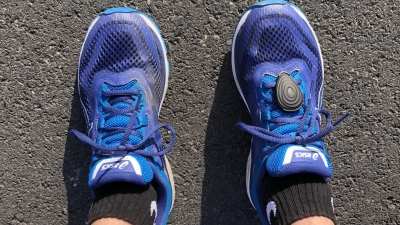
- Do not let running shoes wear out until they are empty; worn out cushioning increases the load on your tendon
- Make it a regular routine to stretch your calf after every running workout
When to see a physiotherapist? If the morning stiffness lasts longer than 1-2 weeks, if the pain during walking does not go away after warming up, or if you feel a thickening of the tendon.
Low back and hip
Low back pain with HYROX has one primary cause: the hips and core are not doing their job. The Sled Push, Sled Pull and Sandbag Lunges are all exercises in which your spine acts as a link between arms/shoulders and legs. If the stabilizing muscles around that link are not strong enough, the lower back takes over the load.
In addition, fatigue is a major aggravating factor. Anyone who is already exhausted in run 7 loses their running position and starts walking hunched over, which is exactly the position that maximizes stress on the lower back.
The riskiest moments in a HYROX race for back problems:
- The Sled Push, especially if you grab too low or your hips hang behind your body
- The Sandbag Lunges, if the bag is too far behind your center of gravity
- The RowErg, for a rounded lower back during the drive phase
- The last running kilometers, when the posture collapses
What helps preventively:
- Strengthen your posterior chain: Romanian deadlifts, hip thrusts, back extensions
- Train your core stability: plank variations, dead bugs, pallof press
- Learn the correct hinge movement (= the basics of Sled Push and RowErg technique)
- Check your running posture when tired: torso upright, look forward, not down
Shoulders and elbows
The shoulder in HYROX is hit from several sides: the SkiErg pulls your shoulders in a repetitive pull-down, the RowErg does the same horizontally, the Sled Pull isometrically, and the Wall Balls push your shoulders overhead: a hundred times, tired, at a high heart rate.
The most common complaint is rotator cuff irritation or impingement: a pinching or painful feeling deep in the shoulder, often during overhead movements or when lying on the side. It develops slowly, but once present it is persistent.
Elbow complaints (particularly lateral epicondylitis or tennis elbow) occur in athletes who do a lot of pulling movements (Sled Pull, RowErg) with an elbow that is too stiffly extended or an incorrect grip technique.
What helps preventively:
- Balance pulling and pushing movements in your training: for every vertical pull also a push
- Strengthen the shoulder rotators: external rotations with band or light weight
- Learn correct Wall Ball technique: no excessive hyperextension in the shoulders at release
- With the SkiErg: don't go all the way to the bottom with your arms. The extra force is negligible, the extra load on your shoulder is not
Shin splints
Tibial pain (medical: medial tibia stress syndrome) is a common complaint in athletes who start running quickly after a period of little running training. It feels like a broad, aching pain along the shin, which appears during or after walking and decreases with rest.
In the HYROX context, we mainly see this in strength athletes or CrossFitters who extend the running portion of their training without sufficient adaptation time. Bones, tendons and the connective tissue around the shin bone adapt more slowly than the muscles. Your condition will improve quickly, but your shin is not yet ready for the extra load.
What helps preventively:
- Build up running volume extremely gradually: shin pain is the typical example of an injury caused by too much too quickly
- Walk in well-cushioned shoes that match your walking pattern
- Strengthen calves and foot muscles: toe raises, single-leg calf raises, short footwork
- Alternate surfaces during training: not always on concrete or sports hall floor
Smart training with complaints
An injury is no reason to stop training. It is a reason to train differently. The trick is not to put further strain on the injury, while maintaining your fitness and strength.
Exercising with knee pain
Knee pain doesn't mean you can't train. It means taking pressure off the knee while addressing the cause.
What you can continue to do:
- RowErg and SkiErg (little knee strain)
- Swimming and cycling (low-impact cardio)
- Upper body strength training
- Core work
What you temporarily adjust:
- Replace lunges with Romanian deadlifts or hip thrusts
- Decrease running volume and intensity; Walking in zone 2 is often pain-free, while interval training causes more complaints
- Work on hip strength and ankle mobility: this solves the underlying cause in many cases
Red flag: swelling in the knee, pain at rest, or pain that gets worse when walking (not better). Then go to a physiotherapist for a diagnosis.
Exercising with low back pain
Low back pain is one of the most common complaints in athletes over 30, and at the same time one of the complaints for which continued training (if done correctly) is usually better than resting.
What helps:
- Temporarily replace Sled Push with variants with less lumbar strain (seated cable rows, trap bar deadlifts)
- Actively train core stability: plank, dead bug, birddog
- Walking training may be done if the pain does not increase: running is rarely the cause of acute back problems
- Avoid exercises that combine a high axial load on a rounded back (classic mistake with RowErg and Sandbag Lunges)
Red flag: pain radiating down the leg, loss of sensation or tingling, or pain that worsens with sneezing and coughing. These are signs of possible nerve compression: see a doctor.
Limited mobility
Limited mobility is rarely an injury in itself, but it is the breeding ground for almost every other injury in HYROX. The three most problematic areas:
Ankle mobility: If your ankle does not have sufficient dorsiflexion (moving the foot towards the shin), you compensate in the knee with squats, lunges and the Wall Balls. Test: Stand with your toe 2 inches from a wall and try to touch your knee to the wall without lifting your heel. Doesn't that work? Then ankle mobility is a priority. Exercise: kneeling ankle stretch, 2 minutes per side daily.
Hip Mobility: Stiff hips lead to compensation in the lower back with almost every HYROX exercise. Couch stretch (hip flexor) and 90/90 stretch (external rotation) are the two most valuable exercises you can do.
Shoulder and Thoracic Mobility: Limited mobility of the thoracic spine and shoulders directly affects the Wall Balls, SkiErg and Sled Pull. Cat-cow, thread-the-needle and thoracic extension over a foam roller are effective daily exercises.
Mobility: the most neglected pillar
When you think of HYROX training, you think of running training, station work and strength sessions. Mobility is not included in most training plans. That's a mistake, and one of the most common reasons athletes get injured.
Mobility is not the same as stretching. Stretching is passively lengthening your muscle. Mobility is active control over a complete range of motion. It involves ankles that flex far enough for a deep squat, hips that rotate freely for an efficient running motion, shoulders that are stable in a fully overhead position.
A short daily mobility routine of 10 to 15 minutes has more effect than a long weekend block of stretching. The key areas for HYROX athletes:
Ankles: kneeling ankle stretch, banded ankle mobilization
Hips (flexion and rotation): couch stretch, 90/90 stretch, hip airplane
Thoracic spine: foam roller extension, thread-the-needle
Shoulders: wall slides, band pull-aparts, overhead mobility drill
Combine this with foam rolling for the calf muscles, IT band, quadriceps and thoracic spine. Foam rolling relaxes the surrounding connective tissue and improves mobility in the short term: ideal as a warm-up before training or as part of your cool-down.
Recovery: when rest is mandatory
The biggest misconception in injury prevention is that rest is the opposite of training. Rest is part of your training. Without recovery, microdamage accumulates in muscles, tendons and joints. And that is exactly how overuse injuries occur.
Active recovery vs. Passive rest: In case of mild muscle pain or fatigue, active recovery (walking, gentle cycling, swimming, mobility work) is more effective than doing nothing at all. It promotes blood circulation and accelerates recovery. Passive rest is only indicated for acute injuries, pain at rest, or swelling.
Sleep is the best recovery tool. Growth hormone (the hormone that repairs muscle tissue) is mainly secreted during deep sleep. Those who chronically sleep too little recover more poorly and are more likely to suffer injuries. 7 to 9 hours is a guideline for intensively training athletes, not a luxury.
Nutrition and hydration as recovery tools: Protein after training (20-40g) supports muscle recovery. Carbohydrates after intense sessions replenish glycogen stores. Chronic dehydration slows recovery and increases injury risk. Keep an eye on your urine (light yellow = good).
The 72-hour rule for tendon complaints: Tendons recover more slowly than muscles. Not in hours, but in days. If a tendon is painful, that structure needs at least 48 to 72 hours of light loading for recovery. If you then do an intensive training, you risk a new load peak on top of a non-recovered tendon.
FAQ
Can I continue training if my knee hurts?
How do I know if my Achilles tendon is a real injury or just muscle soreness?
My knee is bothering me with Wall Balls. Should I skip that station?
Can I do a HYROX with an old or dormant injury?
When do I go to a physiotherapist and when can I adjust myself?
Want to know more about smart training for HYROX? Also view our pages about training structure and periodization, running for HYROX and the individual stations for technique tips that prevent injuries.

Bart Vandenbussche is passionate about sport and never shies away from a sporting challenge. He has run several marathons (including sub-3h), is an Iron+Ultra Viking, and currently has the Hyrox bug.
Question or suggestion?
Do you have a question or suggestion? Let us know!
Tags