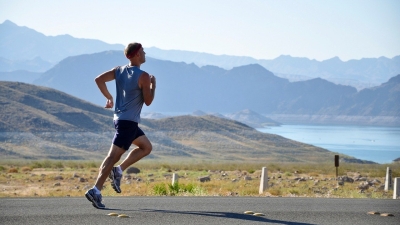
The Achilles tendon is the strongest tendon in the human body. And yet in runners it is one of the most vulnerable spots. Achilles tendinopathy is a stubborn injury that can drag on for weeks to months if handled incorrectly. But with the right approach, full recovery is achievable for most runners.
What is Achilles tendinopathy?
Achilles tendinopathy is a degenerative overuse condition of the Achilles tendon. The term replaces the older name "Achilles tendonitis" (tendinitis), because research has shown that in chronic Achilles tendon problems there is no classic inflammatory process, but rather structural degeneration of the tendon tissue.
The Achilles tendon connects the calf musculature (gastrocnemius and soleus) to the heel bone. With each step, the tendon absorbs and returns energy like a spring. When overloaded, that tissue is damaged faster than it can recover.
There are two forms that you must distinguish, because the treatment differs:
Midportion tendinopathy: pain and swelling in the middle of the Achilles tendon, two à six centimeters above the heel attachment. This is the most common form among runners.
Insertional tendonopathy: pain and tenderness at the attachment of the tendon to the heel bone. More persistent to treat and requires an adapted approach.
Symptoms
The classic presentation of Achilles tendinopathy:
- Stiffness and pain in the Achilles tendon in the morning with the first steps, which disappears after a few minutes of walking
- Pain at the beginning of a workout that decreases after warming up, but returns afterwards
- Swelling or thickening visible or palpable in the tendon
- Pain when palpating (squeezing) the tendon
- In later stages: pain that remains during walking and increases with higher intensity
The pattern "pain upon warming up, gone after warming up" is used by many runners as a justification for continuing to train. That's a mistake. This pattern indicates an active tendinopathy that worsens with persistent loading.
Causes and risk factors
Achilles tendinopathy is almost always an overuse injury. The most common risk factors:
Building up too quickly in volume or intensity is the most common cause. The Achilles tendon adapts more slowly than the calf muscles.
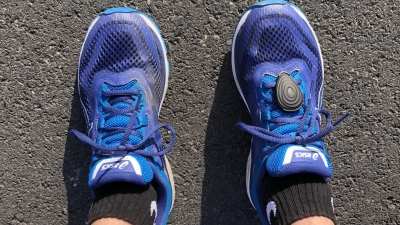
Switching to a shoe with less drop (from high to low drop) increases the stretch on the Achilles tendon. Anyone who does this too quickly overloads the tendon.
Weak or tight calf musculature reduces shock absorption by the muscles and places more stress on the tendon.
Hill training and downhill running increase the eccentric load on the Achilles tendon.
Age: Achilles tendons lose elasticity with age and recover more slowly.
Quick recovery after a period of inactivity: the tendon loses its load-bearing capacity faster than the rest of the body.
Treatment: the proven approach
Step 1: Adjust the training load
Stopping walking is rarely necessary in early Achilles tendon problems, but adjustment is necessary. Reduce volume and intensity. Avoid hill training and speed work. Running forms that place less strain on the tendon (quiet, flat endurance runs) can often be continued.
Step 2: eccentric and isometric exercises
This is the cornerstone of the evidence-based treatment of Achilles tendinopathy. The Alfredson Protocol, developed by orthopedic surgeon Håkan Alfredson in the 1990s, is the best-researched rehabilitation program and is used worldwide.
The protocol consists of:
Heel drops on a step (eccentric):
- Stand with the balls of your feet on a step, heel in the air
- Go up on your toes on both legs
- Transfer the weight to the affected leg
- Slowly lower the heel (3 counts) below the level of the step
- 3 sets of 15 reps, twice a day, seven days a week
- With a straight leg (trains gastrocnemius) AND with a bent knee (trains soleus)
With insertional tendinopathy, heel drops below the level of the step are avoided, because this places a compressive load on the tendon at the attachment.
"Eccentric calf training has become the gold standard for Achilles tendinopathy rehabilitation. Most patients improve significantly within 12 weeks of consistent loading."
Håkan Alfredson, orthopedic surgeon and researcher
Isometric exercises (static contractions of the calf against resistance) are particularly useful in the early, painful phase, as they reduce pain without further overloading the tendon.
Step 3: patience
Achilles tendinopathy does not recover in two weeks. Count on eight à twelve weeks with an early approach. With chronic tendinopathy (present for more than three months), recovery may take six months or longer.
The key: consistency with the exercises, even if it is painful. Mild discomfort (maximum 5 out of 10 on a pain scale) during the exercises is acceptable and not a reason to stop.
What you better not do
Rest alone: Passive rest does not resolve Achilles tendinopathy. The tendon needs mechanical loading to recover and improve tissue structure. Complete rest provides short-term relief but does not solve the underlying problem.
Continue without adjustment: training harder with persistent pain worsens the degeneration of the tendon tissue.
Corticosteroid injections into the Achilles tendon: this is strongly discouraged in case of Achilles tendinopathy. Injections into the tendon itself increase the risk of tendon rupture. Injections around the tendon (peritendinous injections) are sometimes useful for short-term pain relief, but do not solve the cause.
Return to walking
When you can resume depends on your pain level and the progression of the rehabilitation exercises. A useful guideline:
- No more pain during daily activities such as climbing stairs or walking
- Maximum 3 out of 10 pain during and after the rehabilitation exercises
- No increased pain or stiffness the morning after a run
Build back up as per our comeback guide: start with short, easy runs and gradually increase the volume over several weeks.
Frequently asked questions
Can I continue to walk with Achilles tendon pain?
What is the difference between Achilles tendinopathy and Achilles tendon rupture?
Does a heel raiser help?
Is massage useful for an Achilles tendon injury?
In summary
Achilles tendinopathy is an overuse injury that requires an active approach, not just rest. Eccentric calf training via the Alfredson protocol is the best proven treatment. Start early, be consistent, and give it the time it deserves.
→ Not injured yet but want to prevent it from happening? Read the prevention page.
→ Ready to return after your injury? The comeback guide helps you do this safely.
Bart Vandenbussche is passionate about sport and never shies away from a sporting challenge. He has run several marathons (including sub-3h), is an Iron+Ultra Viking, and currently has the Hyrox bug.
Question or suggestion?
Do you have a question or suggestion? Let us know!