Have you ever run a race where you started too fast and halfway through your legs were completely gone? Or done an interval training where you ran too hard on the first repeat, after which everything just got worse? Then you intuitively understand the problem that running with power solves: you only know afterwards how hard you went.
Running with power turns that logic around. You steer on what your body is delivering at this moment, not on what you did yesterday or what your GPS says.
What is power in running?
Power is the amount of energy you deliver per second. The unit is Watt: 1 Watt is equal to 1 Joule of energy per second.
In cycling, training based on power has been the standard for decades. The approach for runners works the same in principle, but is technically more complex. On a bicycle you measure power directly via the force on the pedals. When walking you only use your own body. There is no mechanical contact to measure force.
A power meter for runners therefore calculates power indirectly: via accelerometers that record your movement in three directions (horizontal, vertical, lateral), combined with your body weight, slope, wind speed and direction. The result is an estimate of how much energy you use per second to move your body forward.
Important to understand: the power you see when running is higher than when cycling for the same effort. That's because walking always contains acceleration and deceleration with every step, while cycling is much more constant. So never compare your running wattages with your cycling wattages.
Power, heart rate and speed: what's the difference?
This is the most fundamental concept to understand before investing in anything.
| Power | Heart rate | Speed | |
|---|---|---|---|
| Type of measurement | Input (energy supplied) | Output (response of your body) | Output (result) |
| Reaction speed | Immediately | 30–90 second delay | Slows down on slope/wind |
| Influence of environment | Take wind & into account slope | Affected by stress, sleep, caffeine | Unreliable in wind & slope |
| Influence of fatigue | Stable | Increases with fatigue (cardiac drift) | Decreases with fatigue |
| Suitable for intervals | Excellent | Moderate (reaction too slow) | Good on flat course |
Power is seen as the most direct representation of what your body is doing right now. Heart rate tells you how your body reacts to that effort, with a delay of sometimes a minute or more. Speed tells you what the consequence is, but says nothing about how much effort it costs you.
Practical difference: you are walking up a hill. Your speed drops. Your heart rate increases, but only after 45 seconds. Your wealth will immediately skyrocket. With power you immediately know that you are going too fast, long before your heart rate or feeling tells you so.
"Between 2019 and 2024, I broke my personal records on 5 km, 10 km, the half marathon and the full marathon with power training — from 2h59 to 2h33."
Runner via ProRun
Critical Power: your personal benchmark
Just as heart rate has a maximum heart rate as a reference, power has the Critical Power (CP): also called Anaerobic Threshold Power (ADV).
Your Critical Power is the maximum power you can maintain for one hour. If you go above that, fatigue will quickly build up and you won't be able to keep it up for long. If you stay below it, you work in the aerobic zone and you can continue for much longer.
Everything about power running (your training zones, your race strategy and your pacing) is based on this number. It is the lynchpin of the system.
How do you determine your Critical Power?
With Stryd (the most commonly used power meter for runners) this is done automatically. After three to five varied workouts (a short sprint, a tempo run and a longer endurance run), the app calculates your CP based on your effort profile. The more varied you train, the more accurate the value becomes.
Do you want a reliable value faster? Do a structured test: walk at full speed for 3 minutes, rest for 30 minutes and then run at full speed for 10 minutes. Stryd calculates your CP from this. Repeat this test periodically: your CP will change as you become fitter.
What is a normal CP? Average recreational runners are usually between 3.1 and 4.2 W/kg (men) or 2.6 to 3.6 W/kg (women). Elite runners such as Haile Gebreselassie achieve values around 6.4 W/kg.
Power zones: how do you train with them?
Training zones are determined based on your Critical Power. Stryd works with five zones by default:
| Zone | % of CP | Name | What you train |
|---|---|---|---|
| Zone 1 | < 80% | Recovery | Active recovery, blood flow |
| Zone 2 | 80–90% | Stamina | Aerobic base, fat burning |
| Zone 3 | 90–100% | Pace | Aerobic threshold, marathon pace |
| Zone 4 | 100–115% | Lactate threshold | Anaerobic threshold, 10km pace |
| Zone 5 | > 115% | VO₂max | Maximum oxygen uptake |
Just like with heart rate training, the 80/20 rule also applies here: 80% of your training in zone 1–2, 20% in zone 3–5. The big advantage compared to heart rate: you immediately know whether you are in the right zone. You don't have to wait for your heart rate to catch up.
The benefits in practice
1. Better match format
This is why most runners switch. You can calculate in advance what power you can maintain over a certain distance. Do you start a marathon on your CP power? Then you run consistently. Do you start 5% above that? Then you pay that back in the second half. With interest!
2. Training regardless of circumstances
Headwind, uphill, heat: it doesn't matter for your power target. You always run at the right level, regardless of the course or the weather.
3. Improve running efficiency
A power meter also measures how much energy you lose in vertical movement (bounce behavior) and sideways movement. An efficient runner sends as much energy as possible in the forward direction. Goal: use less watts at the same speed. That is noticeable: a runner who drops from 300 to 270 Watts at the same pace has demonstrably improved his running technique.
4. Optimize interval training
During intervals, the slowdown in heart rate is the most disturbing. With power you know at the first step of an interval whether you are in the right zone. No gambled pace, no half-hearted effort.
5. Preventing overtraining
Because power reflects both cardiovascular and muscular load, you get a better overall picture of how tough a workout really was. Did your heart rate recover quickly but do your legs feel heavy? Your power data tells you that the muscle load was high.
The cons: being honest
Running on power is not for everyone and not without caveats.
It costs money. A Stryd currently costs around €220à €270. On top of that, after the free 6-month membership you have an optional paid membership for the extensive functions. That is a barrier, especially for beginners.
It is not an absolute measurement. Running power is a calculation, not a direct measurement like cycling. The algorithms have improved greatly in recent years and take into account wind, slope, ground contact and temperature, but it remains an estimate. The type of surface (grass vs. asphalt vs. trail) is not always fully taken into account.
The learning curve is real. Setting up, linking to your watch, understanding zones, interpreting data: it takes some time. It's not plug-and-play for everyone.
Beginners will benefit less from this. If you are just starting to walk, the chat test and a little feeling are enough to guide your pace. Power only really adds value if you train in a structured manner with intervals and have a clear competition goal.
Which power meter do you need?
Today, Stryd is the only power meter for runners that is considered reliable and accurate for serious use. Garmin, Polar and Coros also offer a power display via their sports watches or heart rate straps, but these do not measure wind resistance and are less accurate. They can serve as a first introduction, but for competition pacing and serious training, Stryd is the standard.
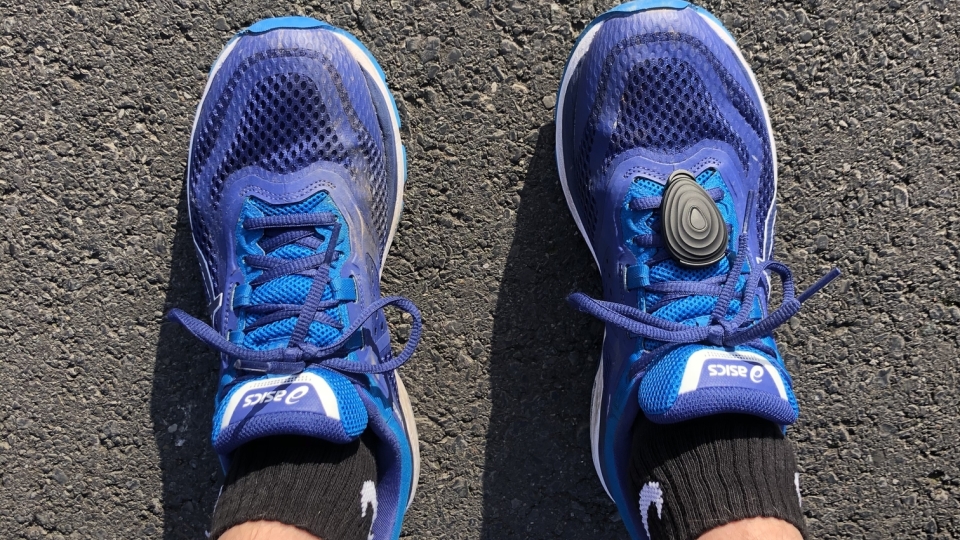
The Stryd is a small footpod that you click on to your running shoe. It connects via Bluetooth or ANT+ to almost all common sports watches (Garmin, Polar, Coros, Suunto). The accompanying app (Stryd PowerCenter) shows your training data, your CP evolution, time predictions per distance and historical analyses.
Stryd 5.0 vs. Stryd Duo 5.0: The Duo version measures with two footpods (one per shoe) for even more accurate data about ground contact, symmetry (left-right difference) and running style. Relevant for runners who actively work on improving technique.
How do you start? A practical entry-level guide
Step 1: Purchase and Install
Order a Stryd, download the Stryd app and connect the footpod to your sports watch. Set your body weight correctly: this directly influences your power calculation.
Step 2: Do three varying workouts
Run a short sprint (10–30 seconds at full speed), a tempo run of 10–20 minutes and an easy endurance run of at least 50 minutes. After these three training sessions, Stryd calculates your first Critical Power.
Step 3: Understand your zones
View your five power zones in the app. Zone 2 (80–90% CP) is your endurance zone: by far the most used zone in training.
Step 4: Train solely on power for two to three weeks
Ignore speed and heart rate temporarily. Focus only on the power on your watch. This calibrates your sense of what the zones mean in practice.
Step 5: Use Target Power in matches
Based on your CP, Stryd calculates a recommended competition power (Target Power) for each distance. Run your first race on that number. Not based on feelings, not on the people around you.
Running on power and HYROX
Those who train for HYROX can also benefit from power running. Although the context is different than a marathon. With HYROX you run eight times one kilometer in a state of increasing fatigue, after each time a tough functional workout. Power helps you to manage those kilometer repeats consistently, even if your legs are heavy and your heart rate is already high before you start the next run.
The concept of compromised running (running while your muscles are already exhausted) becomes controllable when you run at power. You know exactly at what level you can still function, even when your feelings give you a distorted picture.
Since Hyrox is usually run indoors, and you often cannot count on your GPS signal, running on power is ideal for achieving consistent running times.
You can find out more about the HYROX training approach in our HYROX training guide.
Frequently asked questions
Is power running also useful for beginners?
How is Critical Power different from FTP?
My wattage varies greatly from workout to workout. Is that normal?
Can I also use power without Stryd membership?
Do I need to replace my sports watch if I buy Stryd?
Do you also want to optimize your running technique to run faster with the same power? Then read our guide on running technique. Or see how to integrate power into a complete training plan via the HYROX training page.

Bart Vandenbussche is passionate about sport and never shies away from a sporting challenge. He has run several marathons (including sub-3h), is an Iron+Ultra Viking, and currently has the Hyrox bug.
Question or suggestion?
Do you have a question or suggestion? Let us know!