What are proteins?
Proteins or proteins mainly serve to build muscles and enzymes. When there is insufficient fuel available in the form of carbohydrates and fats, the body can also use proteins as fuel. If necessary, the body breaks down its own muscle tissue for this.
Proteins, together with carbohydrates and fats belong to the macronutrients.
Function of proteins
- Building material for muscle growth and recovery
- Transport agent, as a carrier for other nutrients
- Fuel, in case of a shortage of carbohydrates and fats
- Constituent of hormones, such as insulin
- Constituent of antibodies
Protein-rich food
You can find proteins in both animal and plant foods. Try to get your proteins as much as possible from animal proteins.
Animal proteins
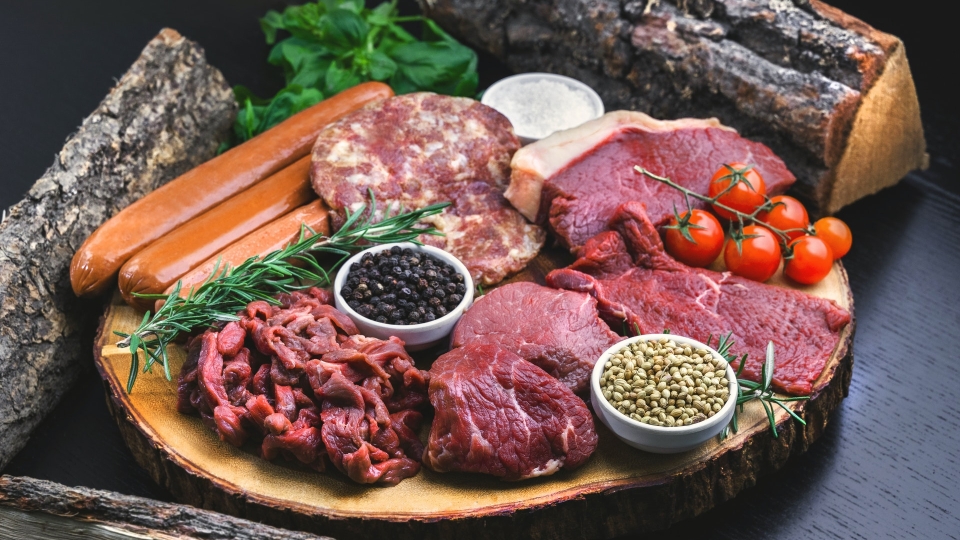
- Meat: chicken, beef, turkey...
- Eggs
- Yogurt
- Fish
- Crustaceans and shellfish
Vegetable proteins
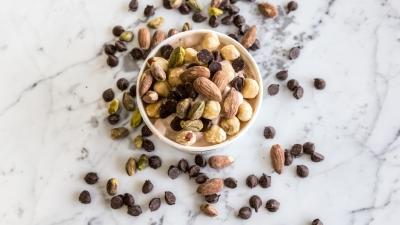
- Nuts
- Seeds
- Kips
- Green vegetables: beans, spinach, broccoli, sprouts...
Healthy proteins
To help you choose healthy proteins, we have created the following table. Try to eat as many products from the green column as possible. The products in the yellow column are also perfect. However, these in the red column are not recommended (although exceptionally possible).
| Green (preferred) | Yellow | Red (not recommended) |
|---|---|---|
| Cheese spread (< 20% fat) Firm cheese (< 25% fat) Ricotta Mozzarella Cottage cheese Flat cheese Cottage cheese |
Cheese spread (> 20% fat) Firm cheese (> 25% fat) French cheeses Mascarpone Goat cheese Feta Herb cheese Cream cheese |
|
| Skimmed / semi-skimmed milk Low-fat / semi-skimmed yoghurt Low-fat / semi-skimmed flat cheese Skimmed / semi-skimmed chocolate milk Low-fat / semi-skimmed drinking yoghurt Buttermilk (unsweetened) Soy drink (unsweetened) Semi-skimmed pudding Kefir Eggs |
Whole milk Full-fat yoghurt Full flat cheese Whole chocolate milk Full-fat drinking yoghurt Buttermilk (sweetened) Soy drink (sweetened) Full pudding |
Cream dessert |
| Chicken fillet Turkey fillet Roast beef Bacon Filet americain Steak Roast beef Beef roulade Tartar Minced chicken Minced veal Pork tenderloin Quorn Tofu Salmon Tuna |
Raw ham Filet americain préparé Ground beef Mixed minced meat Entrecôte Ribs Rabbit Pork chop |
Salami Minced meat Bacon Paté Meat salad Chicken Curry Crab lettuce Tuna salad Lamb Fatty beef Bacon Breaded meat |
| Notes |
How many grams of protein do I need?
The need for protein depends on:
- Age
- Gender
- Physical condition
- Energy content of the diet
- Activity
Opinions on exactly how many grams of protein you need vary. We bundle most of the advice and conclude with our own advice, supported by scientific research.
Protein requirement based on total energy requirement
The health council advises to get 15% of your total energy needs from proteins.
Others believe that you should adjust the protein requirement depending on the body type:
- Ectomorphic: 20-30%
- Mesomorphic: 25-35%
- Endomorphic: 30-40%
And others will divide your protein needs according to your goal:
- Weight loss: 30%
- Maintaining weight: 25%
- Arrival: 20%
Working with a percentage of your total energy needs, however, is a bit outdated, especially for people who exercise a lot. They have a much higher energy requirement, but do not have a commensurately high protein requirement. It is therefore better to calculate your protein needs based on your body weight.
Protein requirement based on your body weight
The absolute lower limit is set at 0.6 grams of proteins per kg of body weight, but it is recommended to eat at least 0.8 grams of proteins per kg of body weight. (source) This amount is sufficient for those who hardly exercise, but as soon as you start exercising you also have more proteins or proteins needed.
How much extra protein you need depends on which sport - and what intensity - you do.
- Cardio/endurance athlete: 1.0-1.6 grams per kg body weight per day (source)
- Strength athlete: 1.5-2.0 grams per kg body weight per day (source)
- Strength and cardio athlete (e.g. football): 1.4-1.7 grams per kg body weight per day (source)
You now have a certain range that you should stay within. But should you rather aim for the upper limit? Or rather towards the lower limit? That depends on the intensity: someone who does gentle cardio for half an hour 3 times a week will have to aim for 1.0-1.2 g/kg/day. Someone who is training for a marathon and runs intensively 5 or 6 times a week should aim for 1.4-1.6 g/kg/day.
Protein needs based on your lean mass
It seems logical to make your protein needs depend on your lean mass instead of your entire body weight. Because proteins are building blocks for your muscles, right? That's right! However, organ mass is still the most protein-consuming tissue in your body.
You also need to know your correct fat percentage for this. This is why calculations are usually based on your body weight.
When to eat proteins?
Many think that it is especially important to eat enough proteins before and after your training, but that is actually not the case. research has shown that taking proteins just before and just after your training does not provide extra muscle mass or muscle strength.
It is important that you eat enough proteins throughout the day. So try to eat about 20 to 40 grams of protein with each meal.
Frequently asked questions
How many grams of protein do I need as a strength athlete?
The more protein, the better?

Bart Vandenbussche is passionate about sport and never shies away from a sporting challenge. He has run several marathons (including sub-3h), is an Iron+Ultra Viking, and currently has the Hyrox bug.
Question or suggestion?
Do you have a question or suggestion? Let us know!