Shin splints is perhaps the injury that affects the most beginners and runners returning from a break. That painful, nagging sensation on the inside of the shin that builds up the further you run and sometimes persists for hours after training. The good news: shin splints can be treated well and prevented even better.
What are shin splints?
The medical term is Medial Tibial Stress Syndrome (MTSS). It is an overuse syndrome in which the periosteum on the inside of the shin becomes irritated by repeated pulling force of the attached muscles and connective tissue.
Shin splints is not a single injury but a spectrum of overload. In mild cases, the periosteum is slightly irritated. In more severe cases, microscopic stress fractures may be present. It is therefore important to distinguish shin splints from a real stress fracture, because they require complete rest.
Symptoms
The typical features of shin splints:
- Pain and tenderness on the inside of the shin, over an elongated area of five to ten centimeters
- Pain that disappears during training but returns afterwards
- Pain when palpating the inside of the shin over a wide area
- In more severe cases: pain that is present at the start of training and does not disappear
The difference with a stress fracture is clinically important. With a stress fracture, the pain is sharp and localized to one point, often more severe, and does not disappear after warming up. Are you in doubt? Have it assessed by a doctor. A stress fracture requires complete walking rest of six à eight weeks and sometimes medical supervision.
Causes and risk factors
Shin splints is almost always an overuse injury. The most common risk factors:
Building up too quickly: the classic pattern is the beginner who starts too enthusiastically, or the runner who picks up after a longer break at the volume where he stopped.
Hard surfaces: walking on concrete or asphalt increases the impact forces per step compared to grass or sand.
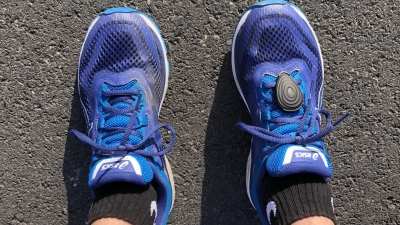
Worn out shoes: shoes that have lost their cushioning effect transmit more impact to the lower extremities.
Overpronation pattern: excessive inward rotation of the foot when landing increases the pulling force on the periosteum on the inside of the shin bone.
Weak hip and calf muscles: reduces shock absorption higher up the chain, causing the shin to absorb more load.
Sudden transition to harder or hillier routes.
Female runners have a statistically higher risk of MTSS, probably due to a combination of a wider pelvis (which affects the Q angle of the knee), hormonal factors and lower average bone density.
Treatment
Phase 1: tax reduction
Shin splints will not recover if you continue to do what caused them. Reduce your walking volume significantly or temporarily pause walking. Alternative workouts that do not strain the shins (swimming, cycling, aqua jogging) keep your fitness level up.
Ice on the painful area (15 à 20 minutes, several times a day) reduces pain and swelling in the acute phase.
Phase 2: recovery exercises
While the complaints decrease, you work on the causes:
Calf strengthening: standing on one leg, lowering it to the heel (heel drop) strengthens the gastrocnemius and soleus, which are connected to the periosteum via their fascia.
Tibialis anterior exercises: the muscle on the front of the lower leg (which lifts the foot) is often involved in shin splints. Foot lifts in a sitting position (pulling the toe up against resistance) strengthen this muscle.
Hip strength training: clamshells, side steps with resistance band and single-leg squats strengthen the hip abductors and improve the stabilization of the leg during landing.
Running technique: a slight increase in cadence (5à 10%) reduces the impact forces per step and is a useful technical adjustment for shin splints. Read more on the cadence page.
Phase 3: gradual return
Resume walking once the pain during daily activities has disappeared and the sensitivity to palpation has decreased significantly. Use ourcomeback guide as a guideline.
How long does recovery take?
With an early approach and a mild MTSS: two à six weeks. In the case of a more serious or prolonged variant: eight à twelve weeks. A true stress fracture requires six à eight weeks of complete walking rest, sometimes longer.
If you resume too early, you start again. That is the most common mistake in shin splints repair.
Prevention
Shin splints is one of the most predictable running injuries. Anyone who knows the risk factors can largely avoid them:
- Build volume using the 10% rule, especially after a break of more than two weeks
- Replace shoes after 600à 800 km
- Train on varied surfaces
- Do targeted strength training for hip and calf twice a week
- Increase your cadence if you have a low cadence combined with a high impact upon landing
Frequently asked questions
Can I continue to walk with shin splints?
How do I know if I have shin splints or a stress fracture?
Do shin socks or compression socks help?
Is taping useful for shin splints?
In summary
Shin splints is an overuse injury that is caused by doing too much too quickly, and is recovered by reducing the load, strengthening the weak links and patiently rebuilding. Treat it early and structurally, and it is rarely a long-term problem.
→ Do you want to prevent shin splints from coming back? Read the prevention page.
→ Ready to resume? The comeback guide helps you rebuild safely.

Bart Vandenbussche is passionate about sport and never shies away from a sporting challenge. He has run several marathons (including sub-3h), is an Iron+Ultra Viking, and currently has the Hyrox bug.
Question or suggestion?
Do you have a question or suggestion? Let us know!