The best injury is the injury that never happens. That sounds obvious, but most runners invest all their energy in training and barely any in preventing downtime. Prevention is only taken seriously once something has already gone wrong. By then it is too late for prevention.
This page explains what you can concretely do to avoid injuries, which risk factors are most prevalent in runners, and how to recognise early warning signs before they develop into real problems.
The most important risk factor: training load
By far the biggest cause of running injuries is doing too much too quickly. Not the walking movement itself, not the surface, not your shoes. The imbalance between what you ask of your body and what your body can handle.
Your cardiovascular system adapts quickly: after two à After three weeks of training you will notice that your heart rate drops and your breathing becomes calmer. But tendons, articular cartilage and bones take three to six times as long to adapt to the same load. That gap is the period in which injuries occur.
The consequence is simple but difficult in practice: build up more slowly than your fitness level suggests. You feel good, you can do more, but your structures are not ready for it yet.
The 10% rule: never increase your weekly running volume by more than 10% per week. Every three à four weeks a recovery week with 20 à 30% less volume. That is not a weakness, that is the way your body becomes structurally stronger.
Strength training: the most underestimated injury prevention
A meta-analysis published in the British Journal of Sports Medicine (Lauersen et al., 2018) showed that strength training reduces the risk of overuse injuries in athletes by approximately 50%. That's an impressive number for something that many runners see as a waste of time.
Why does it work? Strength training strengthens tendons, muscles and bones, improves the muscle imbalances that are almost universal among runners, and provides better stabilization with every step.
The most relevant muscle groups for runners:
Hip and buttock
The gluteus maximus (large buttock muscle) provides powerful propulsion. The gluteus medius (middle gluteal muscle) stabilizes the pelvis with every step. Weak hip abductors are the most common cause of runner's knee, IT band syndrome and knee pain in female runners.
Effective exercises: Bulgarian split squat, hip thrust, single-leg deadlift, clamshells, side-lying hip abduction.
Calf and Achilles tendon
The calf musculature (gastrocnemius and soleus) and the Achilles tendon are involved in every step as a spring and drive. Eccentric calf training (slowly lowering onto one leg) strengthens the Achilles tendon in a way that concentric training does not achieve.
Heel drops on a step, two à three sets of 15 repetitions per leg are the best-substantiated prevention exercise for Achilles tendon problems.
Core and torso
A stable torso keeps the pelvic position straight while walking, reduces rotation of the spine and reduces the load on the lower back and hips. Plank, side plank, dead bug and single-leg bridge are effective basic exercises.
→ Read the complete guide to strength training for runners for a concrete schedule.
Warm-up and cool-down
A good warm-up prepares your neuromuscular system for the training load. Dynamic warm-up reduces the risk of acute complaints and improves running technique by warming muscles and joints.
What an effective warm-up entails: five minutes of gentle walking, followed by dynamic exercises such as knee lifts, heel-buttocks, leg swings and walking lunges. No static stretching before training.
After training, static stretching is useful to maintain muscle lengths and promote blood circulation. Hamstring, calf, hip flexor and quadriceps are the priorities for runners.
→ Everything about the correct warm-up and cool-down can be found on the warm-up page and the cooling-down page.
Running shoes and their role in prevention
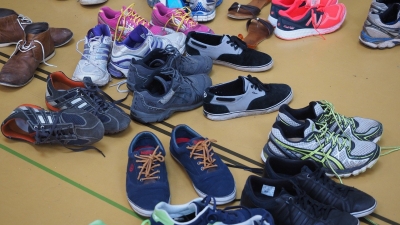
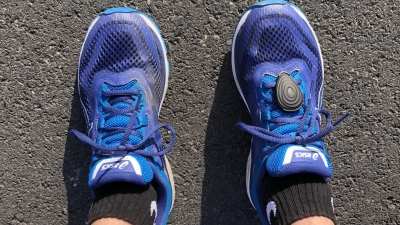
Shoes are less decisive for injuries than is often suggested, but they do play a role. The right shoe for your foot and running style reduces unnecessary stress patterns.
What is relevant when choosing shoes:
Replace your shoes on time. After 600 à After 800 km, the damping effect decreases significantly, even if they still look good from the outside. If you always wear the same shoe, you can alternate between two pairs: this varies the load subtly per training.
Drop (the height difference between heel and toe) influences the distribution of load over the ankle, calf and knee. High drop facilitates heel strike and reduces the load on the calf. Low drop encourages forward landing and increases the load on the calf and Achilles tendon. Anyone who goes from high to low drop always does so gradually.
→ Read the complete guide to running shoes for everything you need to know.
Recognizing early signals
This is where most runners go wrong. An injury rarely announces itself as a sudden, unambiguous complaint. It starts off as a minor inconvenience that's easy to ignore. Three to six weeks later the same discomfort is a problem that costs you months.
Signs that require attention:
Pain that only starts after walking a few kilometers and then remains stable: pay attention. This is an early overload signal.
Stiffness the morning after a workout that lasts more than five minutes before disappearing: increase your recovery and temporarily reduce the volume.
Pain that starts while walking and increases as you walk: stop that training. Don't slow down, stop.
Pain that is present at the start of a workout and disappears after warming up: be careful. This pattern, classic in early tendinopathies, is too often used as a justification for continuing training. The tendinopathy therefore worsens insidiously.
Change in walking sensation for no apparent reason, such as a noticeable asymmetry in your step or a leg that feels heavier: pay attention and observe.
Recovery as part of prevention
Prevention does not stop with training. Sleep, nutrition and stress management are equally relevant.
Sleep is the time when growth hormone is secreted and tissue repairs. Structurally sleeping less than seven hours demonstrably increases the risk of injury in athletes.
Nutrition provides the building materials for recovery. Proteins are essential for muscle recovery. Vitamin D and calcium support bone health. A calorie deficit in combination with high training loads increases the risk of stress fractures, especially in female runners (the so-called RED-S syndrome, Relative Energy Deficiency in Sport).
Mental stress has a physiological effect on recovery capacity. A runner who combines his training with high workload, poor sleep and insufficient calories has a higher risk of injury than his training schedule suggests.
Specific risk factors per running profile
Beginners: the biggest risk is building up too quickly. Following a start-to-run schedule and respecting the 10% rule is the most important prevention.
Runners after a break: your body forgets fitness faster than structural adjustment. After a break of more than three weeks, always start lower than where you stopped.
High volume runners: fatigue accumulation over weeks increases risk. Consciously periodize recovery weeks and keep track of weekly volumes.
Older runners (45+): recovery capacity decreases with age. More rest days per week, more attention to mobility and strength training partly compensate for this.
Frequently asked questions
Should I stop walking at the first pain?
Is stretching really useful for injury prevention?
Does walking on softer surfaces help?
In summary
Injury prevention revolves around three pillars: smart training structure via the 10% rule, targeted strength training for the hip, calf and core twice a week, and taking early signals seriously instead of rushing through them. Anyone who does these three things structurally has a significantly lower risk of failure.
→ Already suffering from a specific complaint? Read the page about achilles tendon injuries, shin splints or runner's knee.
→ Back after an injury? Read the comeback guide.

Bart Vandenbussche is passionate about sport and never shies away from a sporting challenge. He has run several marathons (including sub-3h), is an Iron+Ultra Viking, and currently has the Hyrox bug.
Question or suggestion?
Do you have a question or suggestion? Let us know!