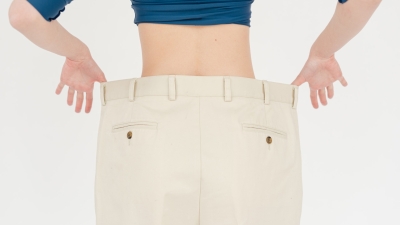
Your BMI says you have a healthy weight, but you still do not feel fit. Or you have been training for months and the scales barely move, while your trousers are clearly looser. In both cases your body fat percentage tells you what your weight does not.
Body fat percentage is the ratio between your fat mass and your total body weight. It is one of the most informative measures of your body composition, although also one of the most difficult to measure accurately.
Why fat percentage says more than weight or BMI
Weight does not distinguish between fat, muscle, water and bone. Two people weighing 80 kg and 1.80 m have exactly the same BMI, but one may have 15% body fat and the other 28%. That makes a world of difference, both for health and for how you look and feel.
Fat percentage provides that context. It tells you whether your weight loss process is at the expense of fat or muscle tissue. It tells you whether your sports performance is accompanied by better body composition. And it gives you a more realistic picture of your health than a scale alone.
What is a healthy fat percentage?
Fat percentage differs significantly between men and women, because women naturally carry more essential fat for hormonal functions and reproduction.
Men
| Category | Fat percentage |
|---|---|
| Essential fat (minimum) | 2 à 5% |
| Athletic | 6 à 13% |
| Fit | 14 à 17% |
| Average | 18 à 24% |
| Overweight | 25% and higher |
Women
| Category | Fat percentage |
|---|---|
| Essential fat (minimum) | 10 à 13% |
| Athletic | 14 à 20% |
| Fit | 21 à 24% |
| Average | 25 à 31% |
| Overweight | 32% and higher |
A fat percentage below the essential minimum is dangerous and is associated with hormonal disorders, reduced bone density and immune problems. In women, too low a fat percentage can lead to loss of menstruation, one of the characteristics of the RED-S syndrome (Relative Energy Deficiency in Sport).
How do you measure your body fat percentage?
There are several methods, each with different accuracy, cost and accessibility.
1. DEXA scan (gold standard)
A DEXA scan (Dual-Energy X-ray Absorptiometry) uses two X-rays with different energy levels to measure fat, muscle mass and bone mineral density separately. It is the most accurate method available for recreational athletes.
Accuracy: margin of error of één &agrav; two percentage points.
Accessibility: Available at sports clinics, some hospitals and specialist centres. Cost varies from 50 à 150 euros per measurement.
Recommendation: ideal as a reference measurement, two à repeat four times a year.
2. Skinfold measurement (skinfold)
A trained measurement of skinfold thickness at fixed measuring points (biceps, triceps, scapula, suprailiac) with a caliper. A formula then calculates the fat percentage.
Accuracy: margin of error of three à five percentage points with a trained meter. Much larger with an inexperienced measurement.
Accessibility: cheap (calipers are available from 10 euros), but requires knowledge of the correct measuring points and consistent technique.
Recommendation: Useful for following trends when always measuring the same person in the same way. Less suitable as an absolute measure.
3. Bioelectrical Impedance Analysis (BIA)
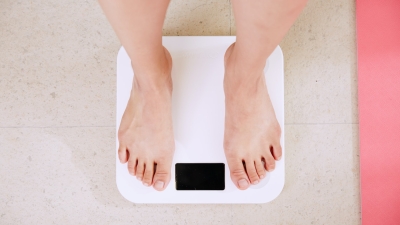
Many smart scales and handheld devices use BIA: a weak electrical current runs through the body and measures resistance. Fat conducts electricity worse than muscle mass, which makes the calculation possible.
Accuracy: margin of error of three à eight percentage points, highly dependent on hydration, time of day and device model.
Accessibility: Very accessible and cheap. Most modern smart scales have BIA built in.
Recommendation: useful for monitoring trends if you always measure under the same conditions (same time, same hydration status). An absolute figure is not very reliable, but the trend over weeks is.
4. Perimeter method (Navy method)
The U.S. Navy method calculates fat percentage based on body circumferences: neck, waist and (in women) hips, combined with height. There are online calculators available for this.
Accuracy: margin of error of three à five percentage points, comparable to BIA.
Accessibility: Completely free, just a measuring tape required.
Recommendation: Good alternative if you do not have a scale with BIA. The method works well for trends, less so for absolute values.
Comparison table
| Method | Accuracy | Cost price | Performable at home |
|---|---|---|---|
| DEXA scan | Very high (±1-2%) | High | No |
| Skin folds | Moderate (±3-5%) | Low | With help |
| BIA (scale) | Moderate (±3-8%) | Low | Yes |
| Navy method | Moderate (±3-5%) | Free | Yes |
Tips for consistent measurements
Regardless of the method you use, consistency is key for reliable trends:
- Always measure in the morning, on an empty stomach and after visiting the toilet
- Do not measure immediately after intensive training (dehydration strongly influences BIA)
- Always measure under the same hydration conditions with BIA
- Always repeat skinfold measurements at exactly the same locations
- Always use the same method for comparisons
How often do you measure your body fat percentage?
Fat percentage changes slowly. Weekly measurements cause too much noise. One measurement every four à six weeks is more meaningful and gives a realistic picture of progress. A DEXA scan requires two à four times a year is sufficient.
Frequently asked questions
My scale gives a different fat percentage than my sports doctor. Which one is correct?
Can I lose fat mass and build muscle mass at the same time?
What fat percentage do I need for a six-pack?
Frequently asked questions
Fat percentage tells you what weight and BMI cannot: whether you are actually losing fat, building muscle, and how healthy your body composition is. At home, a BIA scale is sufficient for following trends. For a reliable absolute measurement, a DEXA scan or skinfold measurement by a professional is the better choice.
→ Combine your fat percentage with body measurements and progress photos for a complete picture of your progress.
→ Back to the Current ME overview.

Bart Vandenbussche is passionate about sport and never shies away from a sporting challenge. He has run several marathons (including sub-3h), is an Iron+Ultra Viking, and currently has the Hyrox bug.
Question or suggestion?
Do you have a question or suggestion? Let us know!
Tags